<h1><strong>WHY IT’S IMPORTANT TO REPLACE MISSING TEETH?</strong></h1> <p>Missing teeth are not merely a cosmetic concern, because they can also severely influence your daily life. A tooth loss condition is really more serious than it is often perceived to be. Lost teeth affect not only oral health but also general health, as well as appearance and self-esteem. Each tooth plays a vital role in the structure of the mouth, and in relationship to the remaining teeth. The way our teeth are normally arranged, helps to facilitate effective chewing, biting and talking.</p>
Teeth are lost or missing for several reasons, such as trauma, decay, gum disease, or even genetics. Tooth loss can negatively affect a person’s social and professional life; it can lead to reduced self-confidence because of the gaps in a smile. Missing teeth can affect the way you speak, depending on the location of the gaps. The loss of one or more teeth can disturb the distribution of bite pressure onto other teeth, resulting in a decrease in chewing efficiency. Your remaining teeth will struggle to retain their normal function due to the imbalance in chewing forces, which can lead to overcompensation by the surrounding teeth, and result in inordinate stress and wear. When you lose a tooth or have a tooth extraction, the bone surrounding the tooth soon begins to weaken, and the surrounding teeth begin to shift to fill in the space, leaving more spaces and gaps. Also, when a tooth is missing, there is no contact with the opposing arch. This can cause opposing teeth to gradually extrude which leads to other problems, such as fractures, mobility, or tooth loss. Tooth loss can also cause infections, affecting the gum tissues and the underlying bone. In advanced cases, it can also lead to progressive bone loss and receding gums. Therefore, leaving the gap where a tooth once was can be a source of embarrassment as well as have serious consequences. So it is very important to replace a missing tooth to prevent the other teeth from shifting. Also replacing the missing back teeth can affect the overall bite, and help ease some of the excessive pressure on the front teeth created by chewing. If the tooth is not replaced soon, the loss of jawbone can cause other teeth to fall out, further detracting from a healthy smile. There is more than one option for replacing missing teeth. The 3 most common options are replacing the missing teeth with implants, crowns, bridges or dentures. Sometimes a combination of two of these options can be used, such as a denture that is supported by implants, or a bridge that is supported by implants. And just as importantly, they can also help teeth to even out the bite forces of the remaining teeth, and protect their existing teeth structure to last for a long lifetime. Not to mention that by saving one tooth, you are also helping to keep the surrounding ones healthy as well. When a person does not replace a missing tooth for a long time, a chain of events starts. Such as over-eruption of the opposite tooth which is now useless, as it does not have an opposing tooth. Tilt of the adjacent teeth leading to drift of adjacent teeth (as teeth tend to move where they get space) as well as gum pockets, decay and bone loss. Over a period of time, this series of events can lead to the loss of all your teeth.
The options of replacing missing teeth are
• Dental Implants
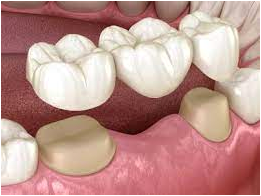
• Crowns and bridges
• Removable partial denture
• Complete denture